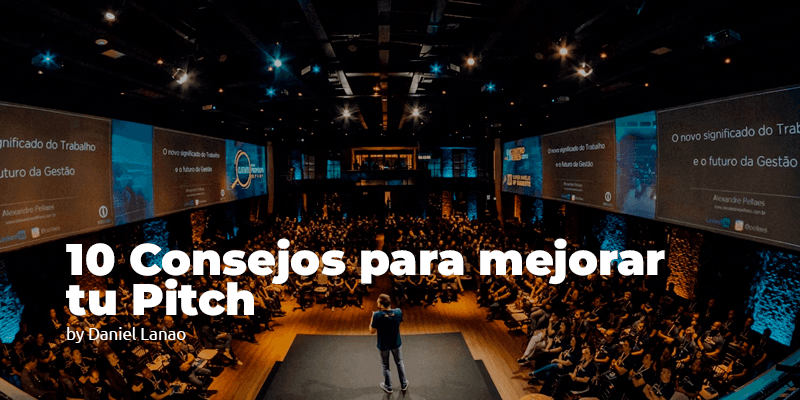
10 Tips to Improve Your Pitch
I recently went to a demo day and was surprised to see how many presenters made, in my view, very basic mistakes when pitching their startup or idea. I've been lucky enough to read a lot on the subject, attend several demo days, and take part in some of them too. I think it would be useful to share a few tips I've internalized — ones that could help founders and anyone who wants to get an idea across.
Here are 10 tips to improve your presentation / pitch:
Have a clear argument
Keep this question in mind: what is the one main idea I want people to remember? Build the presentation and the content from that idea.
A simple technique to keep that idea — or the summary of the talk — clear is to express the argument in 15 words.
Adapt the pitch to the audience
Pitching to investors, founders, a general audience, or scientific experts is not the same thing. Knowing who you're presenting to matters a lot. Once you've identified the audience, build the presentation for them: use the right language, simple ideas, analogies, and so on.
Use a strong structure
In a short amount of time, you can't transmit a lot of information. But you can transmit a few key ideas — or the feeling that the audience now knows more.
Startup competitions usually have a defined structure: problem, solution, value proposition, market, competition, team, traction, roadmap, ask, and call to action.
Outside those competitions, my view is that structure should make the message clear and coherent — the famous "storytelling." For startups, I would emphasize the problem and the value proposition, explaining the "secret sauce" and the impact that solution could have.
Open well
We're in the attention era. You need a hook at the start to spark curiosity and capture — or keep — people's attention. In my experience, what helps most is telling a simple, agile story so the audience can grasp the problem or the idea you're trying to convey.
Create a connection with the audience
Connection helps the audience stay focused on the presentation. Some of the best practices: keep eye contact, show vulnerability, make people laugh a little, and be careful with technical language.
A protagonist with concrete goals stumbles into an unexpected obstacle and a crisis follows. The protagonist tries to overcome the obstacle, which leads to a climax and finally a resolution.
Write a script
Something that surprised me when I read it: TED speakers are advised to write a script for the talk and memorize it. The key is that the script should sound spoken — and in many of the talks I've seen, it never feels memorized.
I find this idea very useful when it comes to making the most of your time.
Visual support — slides!
This is where I think the biggest mistake happens: trying to include every possible piece of information.
I've also seen presentations designed by someone other than the speaker, making it obvious that the presenter isn't familiar with the slides or doesn't flow with them.
You have to spend time on the slides too. Keep in mind that every element you add captures — or absorbs — people's attention. Too many elements and too much content distract the audience.
No images is always better than bad images.
I could write another article on this, but in short, a few important things to keep in mind:
- Image quality and quantity
- Typography
- Font size
- Readability
- Amount of text and information
- Charts
- Contrast
- Effects
- Don't use bullet lists
- Give people time to read
- Color
One last thought on this point: for me, the presentation should delight the audience.
Control pace and time
Personally, it tells me a lot when a speaker finishes in the agreed time. It shows they prepared and managed the pace of the presentation.
What's also essential — and not done often enough — is handling pauses and rhythm. Pauses help emphasize ideas and give the audience time to absorb them.
Both pace and time control can be practiced by writing a good script and following many of the previous recommendations.
Close well
Always look for a call to action at the end of the presentation — and also look to expand what the audience can do next. What fascinates me is when a speaker, with a good script and storytelling, achieves narrative symmetry.
Practice
The most important thing of all: practice.
When you practice, you can rehearse the script, correct it, iterate, time yourself, and refine every previous point.
You can practice with notes, without notes, with recordings, with an audience, without an audience. Feedback from people similar to your actual audience helps you know what landed, what didn't, and whether the idea is worth it.
Practice, practice, and practice.